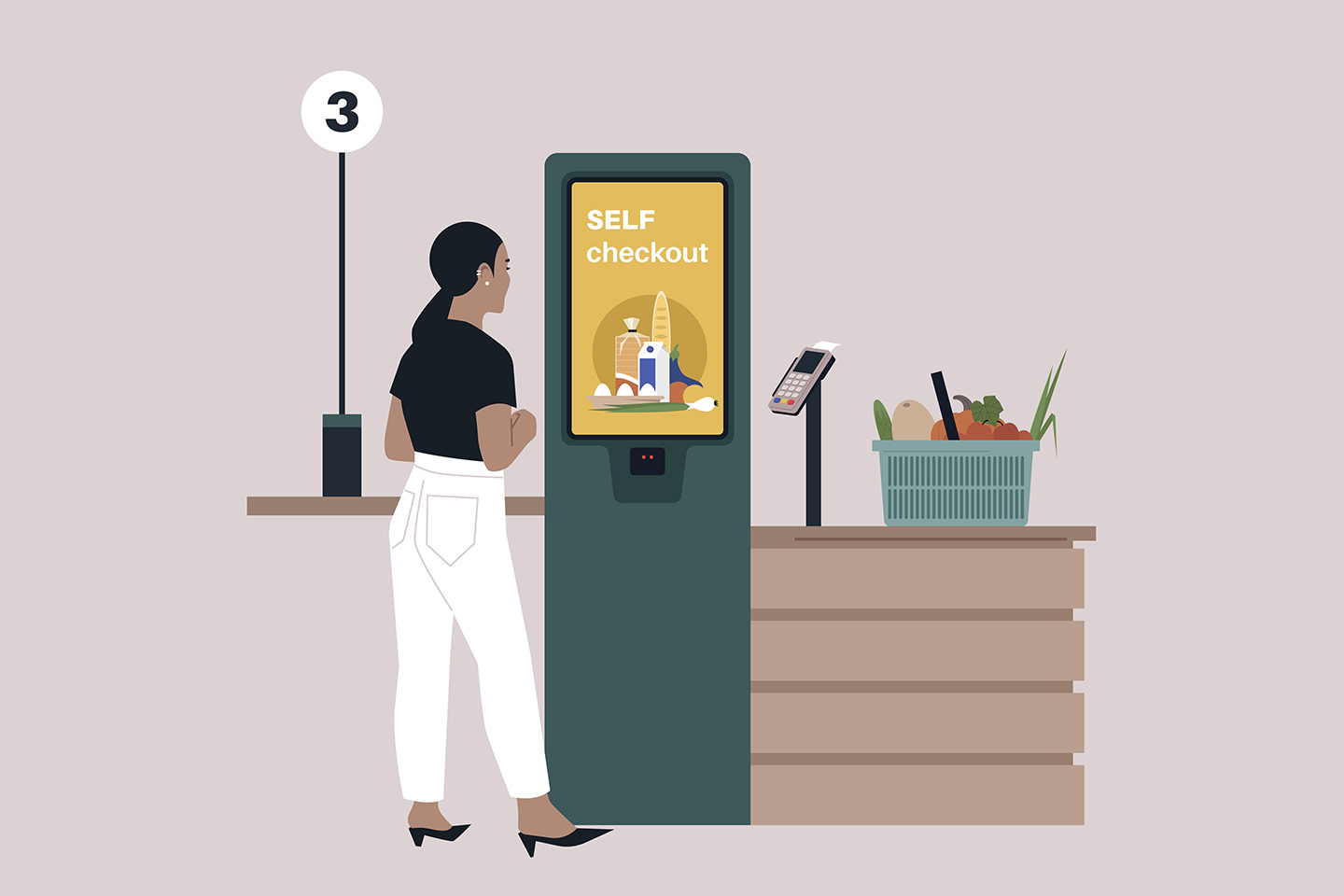
The past decade has seen the presence of digital technologies expand its breadth from merely online to physical stores, for an augmented customer experience. In the retail sector specifically, the implementation of self-serving technologies (SSTs) has started reshaping traditional consumer-retailer relationships.
This article explains how SSTs are impacting these relationships and provides six recommendations to help practitioners navigate this digital evolution. These insights are based on a study drawing on 75 interviews conducted with shoppers in a major grocery store in the French‑speaking part of Switzerland.
What are Self-Service Technologies?
These technologies are now widespread in big-box stores and allow shoppers to scan items themselves and save time in the checkout aisle. They include self-checkout kiosks (e.g., Walmart and Tesco), mobile self-scanning apps (e.g., Scan & Go at Sam’s Club), RFID-enabled self-checkout (e.g., Decathlon and Uniqlo). The Research and Markets Report (2025) mentioned that approximately 73% of consumers desire fast payments in stores and 59% said they were willing to use self-service solutions.
SSTs allow consumers to perform activities by themselves without the intervention of frontline employees. This is changing consumers’ role in the co-creation of value for such retail outlets. Rather than being a passive recipient, the consumer takes on certain roles traditionally performed by employees. Indeed, when they perform employee-like tasks and internalize the firm's logic they are, in essence, accepting unpaid labor and surveillance as part of their role. Indeed, it could be said that they become “partial employees”.
Finding the Right Balance
The challenge is to find the perfect win-win balance between ensuring participation and loyalty from consumers and making efficiency and productivity gains for the company. Through value co-creation, consumers and firms mutually benefit from SST use, as consumers gain convenience or autonomy while firms reduce labor costs and gather data.
Our study drew on 75 interviews with shoppers in a major grocery store in French-speaking Switzerland. We contribute to the strain of literature touching on “partial employees”, a term coined some 40 years ago. More specifically, we investigate consumers’ relationships with retailers in the so-called maintenance phase (i.e., after the initial rollout of the technology) to see how changes in the SST affect the relationship.
Six Recommendations for Practitioners
1. Adapt Behavior to Customer Technological Readiness
Retailers should consider the level of ‘technological readiness’ for each of their client segments. Are their customers equipped and motivated to actively participate in the service process? Moreover, fostering this readiness often requires significant investments in customer education and support. Companies need to allocate resources to developing user-friendly interfaces, providing clear instructions and deploying on-site assistance to guide customers through the initial learning curve. This critical ‘touchpoint’, where the employee walks the customer through the process, is an opportunity to engage with clients. Tech-savvy consumers probably won’t have any trouble using the system; yet, not all clients will be eager or able to scan items themselves, for example. The challenge for retailers is to provide the right level of participation for each client segment.
2. Preserve Human Interaction
Companies should sustain a hybrid model that retains human cashiers, not only to provide service variety but also to preserve the emotional and social value of human interaction. Many consumers are in a hurry, but this is not the case for everyone. Indeed, for specific segments of the population, such as the elderly, shopping experiences are an invaluable opportunity to engage in social interaction. Retailers might consider offering a “slow shopping” experience where customers can take their time to interact with employees if they wish. In an era where automation and self-service options are ubiquitous, such moments of social interaction are becoming even more precious and give consumers an opportunity to feel seen and appreciated as individuals.
3. Integration of Loyalty Card Data
In order to enhance the consumer and his/her family safety and knowledge, loyalty card data can be integrated into the SST. For example, with access to the consumer’s profile and purchase histories, SST systems could detect in real time when a consumer selects products containing allergens previously identified in their preferences or medical constraints. In that context, an automated alert would prevent a risky purchase.
4. Leverage Employees as Facilitators
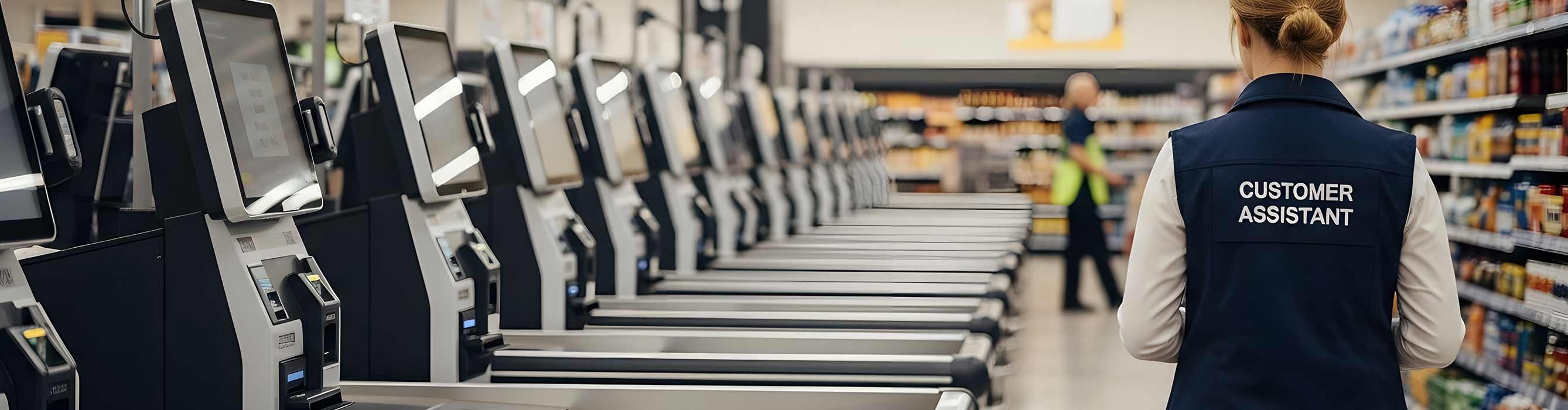
The role of employees is shifting toward more relational functions. Rather than focusing primarily on transactional tasks, employees are becoming facilitators who help customers navigate and effectively use in-store and digital technologies, such as self-checkout systems, mobile apps or AI-driven recommendation tools. They play a key role in resolving technical issues, reducing friction and uncertainty while reassuring customers when problems arise. Through these interactions, employees contribute to building trust in the technology and in the retailer. By blending technological efficiency with human support smooth, the customer experience will be smooth, efficient and positive.
5. Collect Consumer Feedback
Companies should systematically and regularly collect consumer feedback on their SST experiences, including perceptions of fairness, transparency and trust. Such feedback provides valuable insights into how consumers evaluate both the technology and the organization behind it. Importantly, these insights should not remain merely hypothetical, but should be actively used to inform and adjust organizational policies, service design and communication strategies. Implementing SSTs must meet consumers’ expectations and their view of what is and isn’t fair.
6. Transparency on Control Mechanisms
Companies should make control mechanisms more transparent by explaining how random checks work and training frontline employees so they clearly and empathetically communicate this to consumers. Indeed, our study found that bag checks can be a source of frustration for customers. Explaining the situation can go a long way in preventing shoppers from feeling ‘singled out’ if their grocery bags are verified.
Balancing Benefits and Challenges
Despite obvious operational advantages, there are numerous perils for retailers implementing and operating an SST. Retailers need to explain to consumers their SST’s pros (convenience, time savings) and accompany them to overcome the cons (learning to use the system, random checks, etc.). Convincing them of this utility will depend on a number of factors including demographics, tech fluency and customers’ willingness to put in the extra effort to engage with the SST (e.g., to scan and bag their own groceries).
As seen above, SSTs have an impact on employees as well as customers. Retail workers are increasingly ‘facilitating’ purchases and interacting with customers instead of scanning items and swiping credit cards. It will be interesting to see how, as self-service technologies become even more ubiquitous, the relationship between employees and customers will continue to change in the future.