
In the first part of this series, the authors underscored the importance of empathy and communication when managing in a stressful environment. One way restaurant managers can cope is by reducing the size of the menu. In the second half of their article, they dichotomize between human- and results-centered leadership and suggest paths toward a successful and safe workplace.
Two Types of Leaders and…a Third Way
Given the unyielding tension of most restaurants, chefs tend to fall into one of two categories.
The results-driven chef gets through the shift. The recipes are executed flawlessly, standards are upheld. But after a particularly tough service, he leaves the restaurant without a word for his teams. When a line cook makes a pressure-filled mistake, the chef makes the correction without giving his subordinate any explanation. When asked why even the most cumbersome requests must be accepted he replies curtly: “That’s how it goes, we have to”. His team respects him. They start queuing for the exit anyway.
The accommodating chef is liked by all employees. He signs off on last-minute scheduling requests, accepts tardiness without raising his voice, avoids confrontation when a team member consistently underperforms. The atmosphere is positive until a conflict erupts because overly informal arrangements have strained the entire restaurant. His team loves him. They don’t really get behind him though.
Neither of these profiles is good. Solid restaurant leadership must balance rules and compassion. Both are essential. The team or individual mustn’t be sacrificed at the altar of delivering a quality client experience.
The Two Dimensions of Effective Leadership
For greater insight, it is interesting to distinguish between two dimensions of leadership:
1. Making the right decision
The ability to make good decisions that are consistent and comply with standards that are clear and respected by all. This reflects the moral dimension of leadership where everyone follows the rules.
2. The human aspect of decisions:
The ability to account for people’s dignity, the quality of relationships and what work means to each employee. This is the existential dimension of leadership where employees feel recognized not just evaluated.
Where Leadership Dimensions Intersect
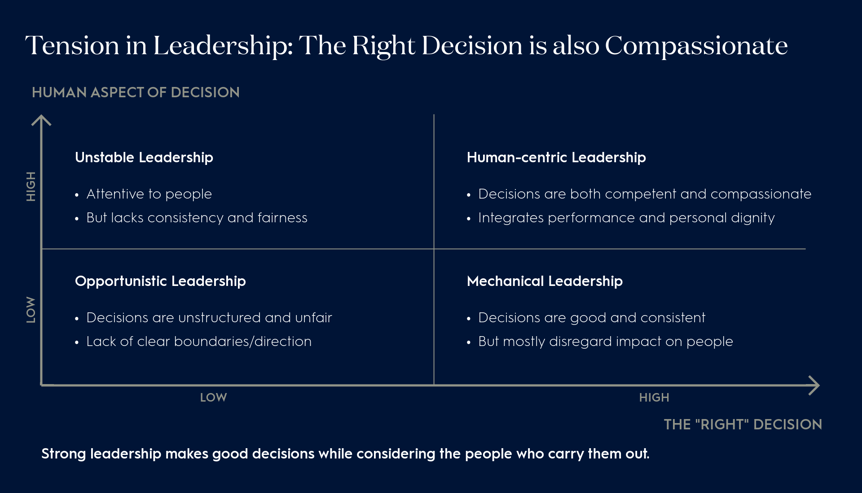
Both dimensions are independent; a manager can be skilled in one and weak in the other. Where they intersect produces four configurations:
-
Poor decision-making/poor people skills: opportunistic leadership. This chef just lets things happen, avoids conflicts, doesn’t respect standards or people. Errors are repeated, no one is corrected, the brigade drifts off-course and guests go home disappointed.
-
Good decision-making/poor people skills: Mechanical leadership. The service goes well, recipes are executed accurately, imperfections are immediately corrected. But no one knows why certain decisions are made, the debrief after the service is merely a laundry list of mistakes made, and there is very little recognition of their hard work. Cooks do their job. They don’t stay long.
-
Poor decision-making/good people skills: Strong interpersonal skills but unstable leadership. The brigade is tight-knit, confidence is real. But inconsistent quality is never addressed, decisions vary from day to day, fairness erodes. Performance suffers after a while.
- Good decision-making/strong people skills: Humanistic leadership. The chef meets standards and recognizes efforts made. He explains why certain decisions were made, holds an honest and open debriefing after a tough service, adjusts workloads when possible. When he accepts a guest request that will be difficult for the team, he doesn’t back down. He informs his brigade. Under this configuration, teams are engaged, they improve and, ultimately, they stay on.
The latter configuration is the sweet spot where you can retain F&B talent.
It’s Not the Decision; It’s How it is Made
In many instances, the difference between success and discontent is how the decision is implemented, rarely the decision itself.
Two chefs announce a shake up in the brigade’s organization. One simply says it is an ‘operational necessity’; the other takes the time to discuss why, acknowledge what is being asked of each team member, and what is actually changing and what is not changing. In both cases, the decision is the same. What is different is how the brigade experiences that decision.
This is also true for touchier decisions made on a day-in day-out basis. This includes trying to straighten out a line cook who is consistently underperforming without coming down too hard on him or her. Or managing a conflict without blindly taking sides. Refusing a vacation request during peak season while acknowledging the consequences for the person. In each case, the decision is the same. It is how the decision is framed that leaves a lasting impression on the team. And this will have an impact on the quality of their work. By extension, the guest experience is a direct reflection of how the team reacts to decisions.
More Meaning in Performance Evaluation Systems
Restaurants are good at documenting standards such as recipes, service procedures, customer satisfaction indicators but struggle to integrate the human dimension. Rules are rarely a cause of employee disengagement. Rather, when following rules erodes staff pride in their profession or the quality of their work it can make them feel like their contribution is being overlooked.
Meaning is a factor that contributes to employee performance. Does recognizing this mean you are watering down performance standards? Retention, performance and engagement are all influenced by the extent to which employees find meaning in what they do.
The notion of psychological security, which refers to whether employees feel they can flag a potential problem, offer an adjustment or admit a mistake without fear of repercussions, is particularly important here. In a kitchen, where pressure is as omnipresent as butter and cream, having this ‘safe space’ is crucial…especially in an environment where mistakes are immediately felt and seen by all.
A brigade where everyone can say ‘I’m not sure about the timing’ or ‘The guest just changed their order, we need to adjust’ is a more nimble machine that makes fewer errors than one where information is withheld for fear of the chef’s reaction. Psychological security is a prerequisite for teams to work well under pressure.
The Best Decisions are Both Competent and Well-Framed
Restaurant leadership isn’t about choosing between complying with high standards or taking care of your brigade. It consists in understanding that one cannot exist without the other.
This is felt in the way in which an unexpected request is dispatched among the stations and the way in which stressed teams are acknowledged for successfully managing a tricky situation and the way in which the head chef debriefs the teams after a demanding shift.
Planning before the service (e.g., menu choices, brigade organization, scheduling, etc.) also plays an important role because it affects what the teams will have to absorb. Some decisions can be perfectly understandable in terms of upholding quality standards but are impossible in terms of what you’re asking your personnel to do. Decisions only become legitimate (accepted, understood, executed by the brigade) when they are the right decision and when there is buy in among staff. Of course, F&B teams appreciate an orderly workplace, but prefer one in which their dignity is safeguarded and there is meaning in what they do. After all, the ‘right’ decision is one that makes sense for the men and women who have to carry it out.


Read Part One
 When Making the Right Decision isn’t Enough in Restaurant Leadership
Humanistic leadership in F&B balances the demands of a gourmet restaurant and staff wellbeing…while upholding the golden rule.
A gourmet kitchen is like an assembly line that is under constant pressure. Myriad problems can arise in an instant: a guest announces an allergy after ordering, a regular customer orders his favorite dish which isn’t on the menu that night, an eight top changes their appetizer during the rush as orders are piling up. In a kitchen, each station is a gear. If one gets stuck the entire brigade comes to a screeching halt. But time is ticking and quality is non-negotiable.
Reuse and reproduction permitted with full attribution to the original author and inclusion of a link to the original publication. All other rights reserved.