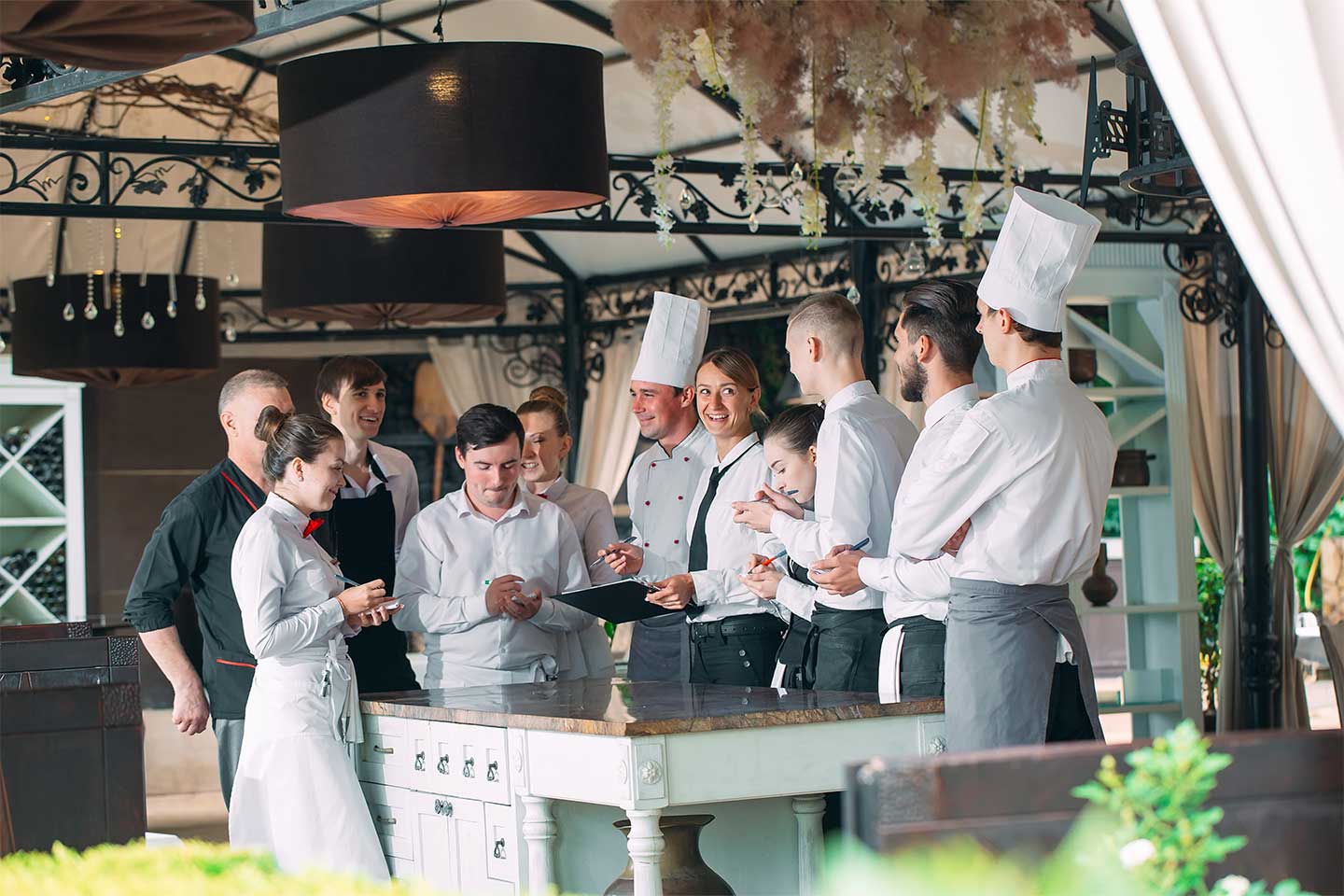
Humanistic leadership in F&B balances the demands of a gourmet restaurant and staff wellbeing…while upholding the golden rule.
A gourmet kitchen is like an assembly line that is under constant pressure. Myriad problems can arise in an instant: a guest announces an allergy after ordering, a regular customer orders his favorite dish which isn’t on the menu that night, an eight top changes their appetizer during the rush as orders are piling up. In a kitchen, each station is a gear. If one gets stuck the entire brigade comes to a screeching halt. But time is ticking and quality is non-negotiable.
The profession’s golden rule of “never say ‘no’ to a customer” is both a call to excellence and a permanent source of stress for the team. Restaurant leadership must balance two competing demands: meeting customer demands without adding additional pressure on teams. Doing what is right from an operational perspective isn’t enough. The human aspects must be taken into account, too.
This article is geared towards anyone interested in the human challenges of the food service industry, where the tension between operational demands and staff wellbeing is higher than in other businesses, and where competent and compassionate leadership often makes all the difference.
F&B: Where Adapting to the Unexpected is a Job Requirement
In most sectors, dealing with unforeseen circumstances is a disruption. In a professional kitchen, it’s the norm. And when the chef ‘sends’ his dish, there’s no going back, the die has been cast.
Rarely does a shift go off without a hitch, which is why all team members must be 100% prepared. Service can’t falter when something goes awry. What is different about the restaurant industry is that clients receive the finished product and are a constant source of instability. The team leader mustn’t react to exceptions; he or she must constantly orchestrate a permanent adaptation to the flow of changes. Traditional management training rarely addresses this type of leadership skill.
One Restaurant, Many Sub-Restaurants
In F&B jargon, a ‘station’ refers to the semi-independent teams with their own timing, organization and standards. A restaurant comprises many stations including one for appetizers, another for fish, a team that grills meat, a separate team for garnishes, pasta, rice, soups, etc., and—last but certainly not least—the dessert crew. This constellation is structurally interdependent. The timing of one team affects all the others. Changes, whether in the front-of-house or in the kitchen, can have a chain reaction on other stations.
When clients request a gluten-free dish, their steak to be well-done or an extra place setting at the table, it causes a cascade of adjustments: verifying ingredients, modifying the timing, coordinating between stations, or adjusting the plating.
The head chef must absorb this complexity in both directions: towards the dining room, guaranteeing a fluid client experience, and towards the brigade, by redistributing the adjustments between stations without overwhelming or disorganizing them.
Between these two competing interests, front-of-house directors play the underestimated role of a ‘pivot’. Their duty is to maintain the pace of the brigade while delivering excellent service. They receive the request from the client, evaluate what it means for the kitchen, and decide how (and when) to transmit it. This is an act of leadership in itself.
When Staff Shortages Add to the Stress
Tension between the kitchen and the dining room is tough to manage to begin with. An enduring shortage of personnel and perpetually high turnover exacerbates the situation. This is particularly glaring among sous-chefs and other experienced candidates.
Brigades are thinner than ever and subs are harder and harder to come by, yet clients are still as demanding as ever. Putting teams under greater pressure is both a human resource problem and a direct operating risk. When an employee quits, a skillset is lost, the replacement must be trained, which piles on the pressure for staff members. All the while, a restaurant manager can’t cut menu prices if a new cook isn’t as skilled as the one who has recently left. It’s a vicious circle: employees quit, current staff feels more pressure, other employees follow the recently departed.
The tight job market in food service makes decisions more difficult in unexpected ways. A chef may hesitate before dismissing an underperforming subordinate, because they know that it might take weeks or months to find a suitable replacement. Knowing this, retaining competent workers is more important than knowing how to fire them, which highlights just how crucial preventing employee disengagement is. Preserving staff wellbeing strengthens the restaurant’s long-term viability.
When the Golden Rule Turns Toxic
The ‘customer is always right’ doctrine (or dogma) underpins the food service industry. It determines reputation, loyalty and excellence. Moreover, anticipating their needs before they ask is what separates an ordinary restaurant from an excellent one. It is what keeps loyal customers coming back.
This maxim can become toxic, however. Indeed, if it is applied without giving thought to staff members’ wellbeing, it can be exhausting—or even humiliating—for the team. In the long run, it can hollow out the very essence of hospitality.
Let’s take a closer look at how this tension can play out in both sectors of a restaurant.
In the kitchen
When a guest places their order then informs the waiter they have a severe allergy, the golden rule says that the restaurant must find a solution. This means that the chef must offer a credible alternative with whatever is in the fridge. How do they translate this constraint with their brigade without piling on additional pressure? Repeating the mantra, ‘we must do what the customer asked’ without acknowledging the effort it will take will further stress teams. Adding ‘Thanks a lot guys, I know this means more work tonight’, the same decision will likely be better received.
In the dining room
A client complains vociferously about their meal. Managing the situation while protecting the restaurant’s reputation is the only solution. All too often, however, the following questions aren’t asked: How do I deal with the line cook who made the mistake? Do I explain what happened? Acknowledge the difficulty of their job? Leave them alone to wallow in their humiliation?
In both scenarios, the golden rule is not jeopardized. In reality, what changes is the reaction, which enables their team to uphold the golden rule without enduring unneeded stress.

Reducing the Menu: a Pragmatic Response to a Real Constraint
Faced with persistent staff shortages, many establishments have made the decision to pare down their menu, or even offer just one set menu. For the chef, it is more a question of survival than ideology. Multi-page menus require greater operational complexity. Each dish is different: different ingredients, different prep/cooking techniques and different timing. This makes coordinating between stations all the more difficult. More interdependence requires a larger and more experienced brigade.
And yet, with the aforementioned scarcity of seasoned professionals, the equation becomes untenable: maintaining an ambitious menu with fewer hands on deck means additional workload and more mistakes, not to mention the risk of employees jumping ship.
Cutting back on the number of items on offer helps ease a major constraint but there is another collateral effect. Easing interdependency between stations makes service easier. Quality is maintained or even improved as working conditions improve.
Choices about the menu, setup and brigade structure have an outsized impact on how much stress teams will have to absorb during the service. Sometimes there is no choice; being aware, however, that there is no choice makes managers’ work easier.
In conclusion to this first part of our article, we can say that couching difficult decisions in a human-centered way is essential to both attenuate any negative consequences they might have and ensure their successful implementation. In the second half, we offer concrete techniques that leaders can use in the kitchen and other organizational environments when making various decisions.


Read Part Two
 Solutions to Managing Stress in Restaurants and Beyond
In the first part of this series, the authors underscored the importance of empathy and communication when managing in a stressful environment. One way restaurant managers can cope is by reducing the size of the menu. In the second half of their article, they dichotomize between human- and results-centered leadership and suggest paths toward a successful and safe workplace.
Reuse and reproduction permitted with full attribution to the original author and inclusion of a link to the original publication. All other rights reserved.