Have you ever considered investing in liquor? This article takes a deep dive into the world’s most popular spirit, which remains largely unknown in Western markets—baijiu. The Chinese spirit has been attracting increasing attention as an alternative investment.
Some luxury assets are hidden in plain sight. A painting hangs in a private room. A rare watch is tucked away under a shirt. Baijiu, by contrast, has long lived at the center of the dining room table.
Poured at weddings, banquets, business dinners and state occasions, Baijiu carries with it centuries of Chinese culture. However, a new narrative is emerging. The world's most widely consumed spirit is increasingly being regarded not only as a beverage, but also as an item to collect, preserve, and maybe even invest in.
This raises an exciting question for collectors and investors looking for alternative investment opportunities: could investing in liquor move beyond fine wine and rare whisky to include Baijiu, China’s emblematic spirit? Our recent study with Shutian Li (EHL alumna) explores this question using data from over 20,000 auction transactions over more than a decade. We examine whether Baijiu can be considered a viable investment option, the factors that influence its price and how it compares with traditional assets, collectable spirits and Baijiu-related stocks.
A Chinese Spirit Still Understood Too Little
For many readers outside Asia, the first question is simple: what is Baijiu?
Baijiu is a traditional Chinese spirit, usually distilled from grains such as sorghum, rice, wheat, corn or glutinous rice. It is typically clear, potent and aromatic, with flavor profiles that vary by region and production method.
To call it a Chinese liquor is accurate but incomplete. Baijiu is woven into China’s social, business and ceremonial life. It is used to celebrate like Champagne, given as a gift like chocolate, collected like whisky and used to signal status like fine wine.
Baijiu dominates the Chinese spirits market and is often described as the world’s most widely consumed spirit. Yet internationally, it remains far less known than whisky, Cognac, tequila or Bordeaux wine. This gap makes Baijiu particularly appealing and interesting to explore.
From Banquet Table to Auction Room
Baijiu's investment story follows a familiar pattern. Fine wine was initially valued for its drinking pleasure before it became a financial asset. Rare whisky followed the same path. Chinese Baijiu is now undergoing a similar transformation. Historically, the finest bottles were purchased for consumption, gifting or ceremonies. Over time, however, producers, vintages and special releases began to attract attention in secondary markets. Collectors started to care about factors such as packaging, provenance, condition and brand prestige.
The Moutai brand has become the benchmark for premium Baijiu and, at one point, even the most valuable Chinese company by market capitalization. It enjoys exceptional recognition in China and has strong cultural symbolism, as well as being available in limited, collectable formats. A bottle of Moutai can represent hospitality, status, nostalgia, national identity and financial speculation all at once.
Investing in liquor: What Makes Some Baijiu Bottles More Valuable Than Others?
In luxury markets, a brand is a visible indicator of quality, trust, heritage and social recognition. The same is true for Baijiu. Moutai fetches a substantial premium, while other luxury spirits brands, including Wuliangye and Xijiu, also have a strong market position.
Commemorative bottles, special releases, vintage editions and limited releases can attract interest due to their scarcity or cultural significance. However, rarity alone is not enough; a release linked to a significant event, year or cultural reference may be more appealing than a standard bottle. Larger or unusual bottle sizes are prized because they are rarer and more impressive for display or gifting. Original packaging can support authenticity and provenance. The reputation of the auction house also plays a part. Trust is always essential in the world of collectables.
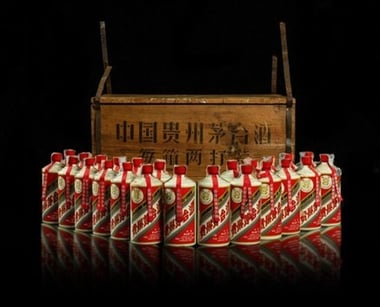
The illustrative example of Kweichow Moutai 'Sun Flower' 1974 presented below is revealing.
Returns, Diversification and Risk
The appeal of investing in liquor lies partly in its differences from traditional financial assets. The price of bottles is influenced by culture, scarcity, collector sentiment, wealth creation and brand desirability. This makes them useful for diversifying investments.
Our research shows that Baijiu has performed strongly over the long term. It displayed returns of around 6% over the period 2010-2023 and even of 30% between 2010 and 2021. It also showed relatively low correlations of around 0 with traditional financial assets, suggesting that Baijiu could provide diversification benefits. This is why Baijiu is becoming a popular choice for investors looking to diversify their portfolios. Like art, fine wine, collector watches or vintage cars, it can provide financial returns while offering emotional and cultural value.
However, Baijiu prices have been more volatile than the Chinese stock market, with sharp declines in some periods, particularly in 2022 and 2023 (a drop of around 12% in value and a maximum drawdown of 60%). A rare bottle requires the right auction, buyer, authentication, storage and insurance…as well as patience. While the asset may be liquid in the glass, it may be illiquid in the portfolio.
Should You Invest in Bottles, Baijiu Stock, or Both?
Investors can either buy physical bottles or gain exposure to Baijiu through the stock market. Our study suggests that shares in major listed Baijiu producers often provide a more accessible beachhead to the industry. These shares are easier to buy and sell, more transparent in terms of pricing, and more familiar to conventional investors. This does not make bottles irrelevant, however. Owning shares of stock also comes with exposure to the vagaries of revenues, margins and relative brand strength. A bottle, however, offers tangibility and emotional ownership, while being more unique.
In short, buying a bottle means investing in a cultural and symbolic asset, and securing a share of that symbolism to be experienced at a future tasting. Buying a share, by contrast, means investing in a financial asset and betting on future cash flows.
Why Hospitality Should Pay Attention
In the hospitality industry, the rise of Baijiu as a luxury asset signals a change in taste, influence and cultural confidence. Hotels, restaurants, private clubs and luxury retailers recognize the storytelling power of wine and spirits. As Chinese luxury consumers travel, collect and shape global expectations, Baijiu may increasingly follow a similar trajectory.
Yet Baijiu remains underrepresented on many international beverage programs. Operators who understand the category can differentiate themselves, educate guests and connect with a spirit that has deep cultural significance. When handled well, Baijiu can spark conversations about culture, Asian spirits and the globalization of taste.
Baijiu is a Cultural Asset Worth Watching
The story of Baijiu as an investment should not be reduced to returns alone. The most compelling luxury assets lie at the intersection of passion and performance. As the luxury market becomes more globalized and investment tastes become more diverse, Baijiu may evolve from being the world's most widely consumed spirit to becoming one of its most sought-after collectables. For those interested in investing in liquor, the next great story may begin at a Chinese banquet, with a small glass raised during a heartfelt toast.


Reuse and reproduction permitted with full attribution to the original author and inclusion of a link to the original publication. All other rights reserved.