
Sustainability certifications like Green Key, LEED, EarthCheck and GSTC are increasingly gaining recognition as trusted indicators of responsible hospitality. According to Booking.com’s 2024 Sustainable Travel Report, 83% of travelers affirm that sustainable travel is important to them, and 45% of travelers believe that sustainability certifications make accommodations more appealing.
With skepticism around greenwashing growing, third-party certifications provide assurance to travelers that hotels are indeed engaging in responsible practices across environmental, social and economic dimensions (ESG). Hotels gain in visibility, competitiveness and operational efficiencies. In order to be compliant with certifications, hotels cut costs related to electricity, water and waste. Just as importantly, they prepare properties for the future by aligning with investor expectations and emerging regulations, as highlighted by J. Walch, Owner & Founder of Rote Wand Hotel, Eco-Hospitality Pioneer. Guests, who actively seek sustainable options, are often willing to pay premium rates, and tend to reward certified properties with higher occupancy and stronger loyalty.
“Certifications are no longer a nice to have. They’re a revenue driver.”
-Elin Kann, Director of Sustainability & Culture Design Hotels
However, faced with a growing number of sustainability certifications, many hoteliers struggle to identify which certification best fits their property. As part of an EHL Student Business Project (SBP), a team of six final-year bachelor students at EHL Hospitality Business School (Jumana Alshanbari, Virginia Savoca, Dhhra Soni, Tala Attar, Jan De Iaco and Emma Fogagnolo), coached by Dr. Jie Yu Kerguignas, investigated this issue over a nine-week consulting journey. The outstanding quality of their research and recommendation enabled them to win first prize for the Best SBP project among more than 70 teams in that cohort. The key findings of their research are summarized below.
Types of Certifications in the Hospitality Industry
Two categories dominate: building-focused certifications (e.g., LEED, BREEAM) that emphasize design, energy and infrastructure; and operational certifications (e.g., Green Key, GSTC, B-Corp, EU Ecolabel) that assess day-to-day management, sourcing and guest-facing practices. Together, they showcase sustainability across the entire property.
In hospitality, several sustainability certifications are commonly adopted; their main strengths and limitations are summarized in Figure 1 below:
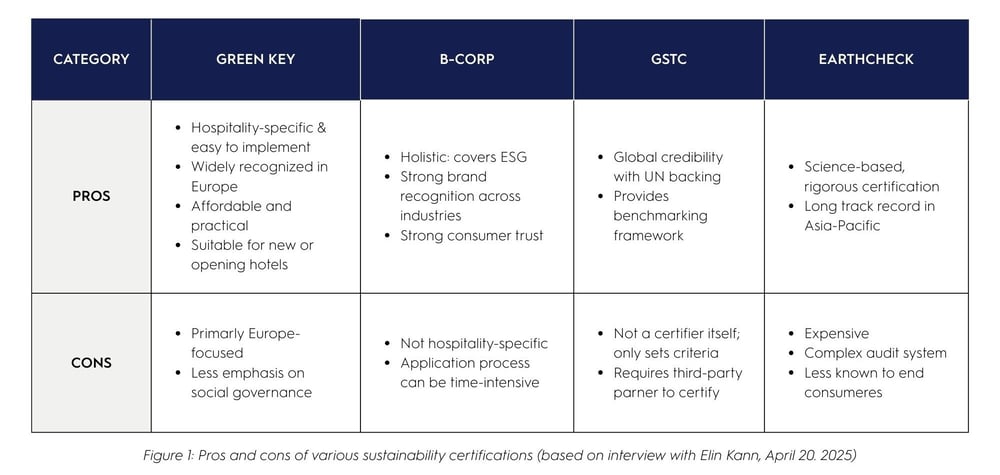
Certifications are not one-size-fits-all; the choice depends on multiple factors and in some cases, a combination of certifications can help hotels strengthen credibility, meet regulatory requirements and appeal to both guests and stakeholders.
Tourists’ Awareness of Certifications
While sustainability is becoming a decisive factor in hospitality, Figure 2 reveals a clear communication gap, which were identified through interviews conducted with 65 participants including sustainable luxury guests, business travelers and executives. Although guests generally appreciate sustainability initiatives and certifications, only a minority are able to recognize them explicitly. This suggests that certifications alone are not sufficient to convey sustainability efforts unless they are translated into visible and relatable guest experiences.
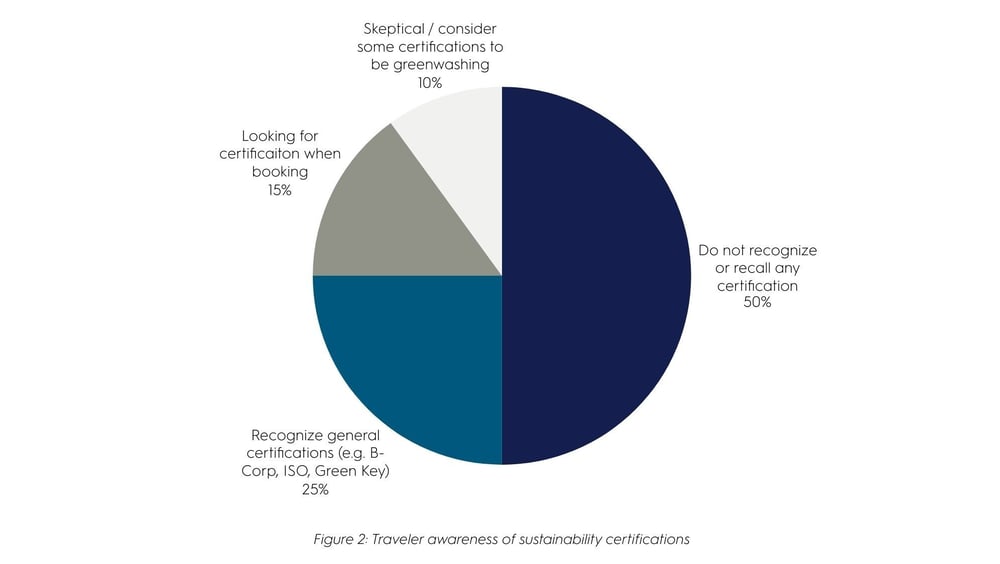
While certifications remain essential as proof of credibility, especially in an era of growing concern over greenwashing, they need to be supported by actions that guests can directly perceive.
Bridging this communication gap means making certifications tangible through concrete guest-facing actions, such as visible energy-saving measures, refillable amenities, locally sourced menus and transparent in-room communication. These actions help translate abstract sustainability commitments into practices that guests can directly observe and associate with credible and authentic efforts. In this sense, even when travelers do not explicitly recognize sustainability labels or logos, they may still perceive and value the underlying practices implemented by the hotel.
Different Guests, Different Priorities
Sustainability and certifications matter to most travelers, but it depends on the type of guest. The research highlights clear differences between leisure and business travelers.
Leisure Travelers:
- Sustainability Seekers value certifications, seek eco-friendly stays and take certifications and labels into account when booking. They prefer longer trips (4–5 nights) and reward visible practices such as organic dining and energy efficiency.
- Cultural, Slow Travelers care less about certification logos and more about authenticity, such as farm-to-table meals, vineyard visits and immersive cultural activities.
-
Wellness Seekers link sustainability with personal well-being, preferring eco-spas, yoga and nature immersion. Certifications build credibility but experiences drive choice.
-
Revelers stay for a short period (2–3 nights) and do not seek certifications directly yet still value visible eco-initiatives like refillable amenities and locally-sourced menu items.
For these leisure segments, certifications work as trust signals, but they only resonate when made tangible through guest-facing practices and experiences.
Business Travelers:
-
Corporate buyers look for certifications in order to meet ESG and procurement requirements.
-
Executives find certifications reassuring but still prioritize Wi-Fi, dining convenience, transport links and loyalty programs
-
Corporate retreats may select eco-friendly venues for team building events, but only when they are accessible and within their budget.
For the business segment, sustainability is valued but rarely decisive; business travel choices are primarily shaped by budget, location, connectivity and efficiency; certifications play a secondary role.
Key Takeaway
Sustainability certifications are less about labels and more about trust. Guests value authentic practices backed by third-party proof, making certifications both a shield against greenwashing and a lever for differentiation. For hotels, sustainability becomes a strategic driver of loyalty and long-term competitiveness.
The group also focused on the concept of quiet luxury and how this trend is reflected within the hospitality industry. They present their key findings and recommendations through the article “Luxury Hospitality Moves Beyond Opulence".
References
Bianco, S., Bernard, S., & Singal, M. (2022). The impact of sustainability certifications on performance and competitive action in hotels. International Journal of Hospitality Management, 108, 103379.
Cassinelli, B. (2025, January 27). The value of sustainability certification in hospitality. Boutique Hotel News. https://boutiquehotelnews.com/features/sustainability-certification-hospitality/
Kann, E., & Singhal, H. (2025, February 7). Green building certifications: What hotels need to know. Open Source and Free Hotel Booking Management Software. https://qloapps.com/green-building-certifications-what-hotels-need-to-know/
Sustainable Hospitality Alliance. (2021). Benefits of hotel sustainability certification. In Sustainable Hospitality Alliance [Report]. https://sustainablehospitalityalliance.org/wp-content/uploads/2021/06/Certifications-factsheet.pdf
Yi, S., Li, X., & Jai, T. (2016). Hotel guests’ perception of best green practices: A content analysis of online reviews. Tourism and Hospitality Research, 18(2), 191–202. https://doi.org/10.1177/1467358416637251

Pictured from left to right are: Virginia Savoca, Jumana Alshanbari, Emma Fogagnolo, Tala Attar, Jan De Iaco, and Dhhra Sonia.