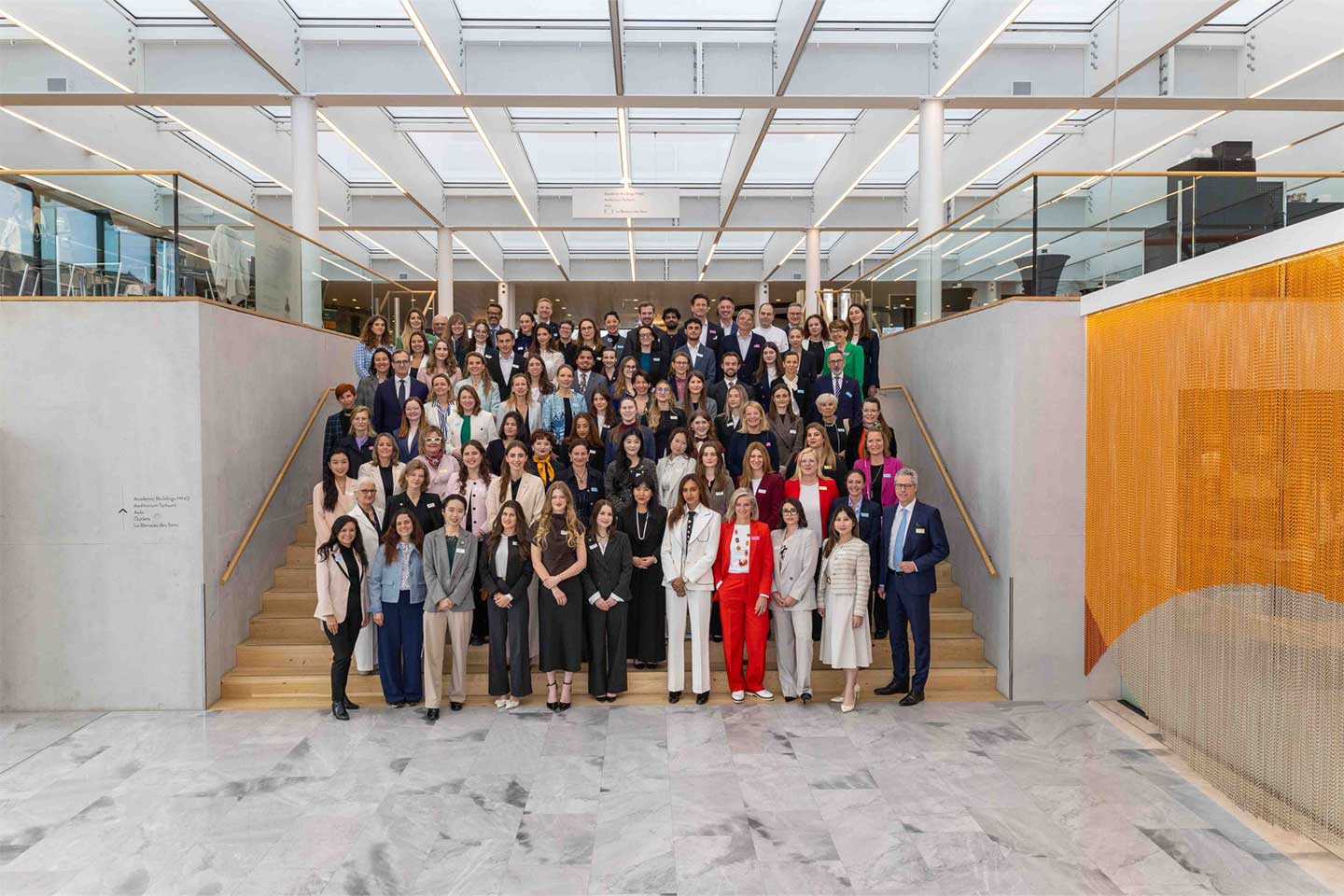
The Women in Leadership Day 2026 brought students and industry leaders together to slow the conversation down and ask a probing question: What must remain human-centric in leadership as technology accelerates? Interestingly, the insights that emerged were less about tools and systems, and more about judgment and presence. The event opened up a rare space for reflection on what leadership must protect as it evolves.
There is a particular kind of energy and authenticity that fills a room when students and senior executives sit down together as genuine equals. That is what WIL Day has always been about. Now in its fourth edition, and this year under the theme Synergy in the Digital Age, roughly a hundred participants gathered at EHL Hospitality Business School: half students, half seasoned professionals from across the industry, from managers to board-level executives. What the students brought, as they always do, was the kind of clarity that comes from seeing the world without the weight of what came before. What the professionals brought was something no algorithm has yet learned to replicate: hard-won judgment, earned through years of navigating real organizations with real people.
Together, we spent a full day being curious and asking difficult questions about AI and leadership. What does it mean to lead in a way that keeps the human being at the center of the equation?
Human-Centered Leadership in the Age of AI
These questions are no longer abstract. AI is already woven into how organizations operate: drafting reports, processing data, suggesting decisions and monitoring performance. It does not stop, it does not get tired and, increasingly, it does not wait for permission. This acceleration is what makes the leadership conversation so urgent and so necessary to hold in person, face to face, with the full range of experience and generation in the room.
One of the sharpest discussions of the WIL day came from our students, who examined what they called the infinite workday and got something important right. The infinite workday, they argued, is not about working longer hours nor working harder; it is about how we define the value we bring. When availability becomes a performance signal, when switching between tasks every three minutes is normalized, when the boundary between work and everything else disappears, what suffers first is not productivity. What suffers is judgment. And judgment is precisely what leaders are there to exercise.
When Convenience Replaces Judgment in Leadership
This connects to a deeper concern. Practice builds capability, but when tools generate solutions independently, the human capacity behind those solutions can start to atrophy. AI offers speed and convenience, yet convenience applied without awareness can erode the humanity on which leadership depends. The risk is that leaders gradually stop leading. They start deferring to systems, trusting outputs without questioning them and so, lose the habit of genuine human judgment.
Leadership has always been hard. That is something I have believed for a long time, and it is a conviction that only deepens with time. What AI has done is not make leadership harder but render its quality more visible. Leaders are under scrutiny in ways they never were before.
At the same time, the gap between what AI can simulate and what a human leader actually delivers is narrowing. AI can express empathy. It can draft persuasive communication. In some carefully bounded contexts, research has shown that it outperformed senior executives on specific tasks. However, what it cannot do is initiate a genuine relationship. It can respond patiently, accurately, at scale, but it cannot call to check in. It cannot sense when the same words will land differently with different people. It cannot read the political and cultural texture of a room and decide, in that moment, what the right thing to say is.
These are the diagnostic tools of real leadership; to understand more than just what is happening in their organization. It’s necessary to understand why and what it means for the people inside it. As AI takes on more of the task-based work, these capabilities become sharper differentiators. If a leader cannot demonstrate them, the gap between what AI can simulate and what they actually bring becomes disturbingly narrow.
AI Impact on Workplace Culture
There is also a cultural dimension that organizations are not yet taking seriously enough. Rather than create culture, AI actually amplifies whatever culture already exists. In a genuinely people-centered organization, it can accelerate trust, inclusion and growth. In a broken one, it becomes a mechanism for control: measuring, monitoring and reducing people to data points. The technology is a mirror; what it reflects depends entirely on the humans who shape it.
What WIL Day reminds me of every year is that slowing down is not a retreat from the pace of change. It is a precondition for leading through it. You cannot guide people through uncertainty if you are not anchored yourself. You cannot inspire trust while running on cortisol. And you cannot build the kind of culture that AI can amplify for good if you have not first done the patient, unglamorous work of actually building it.
The room was full on WIL Day. The conversations were honest, the energy was real. This is not something a system generates. If we look closely, this is something humans choose to create and will continue to keep choosing.