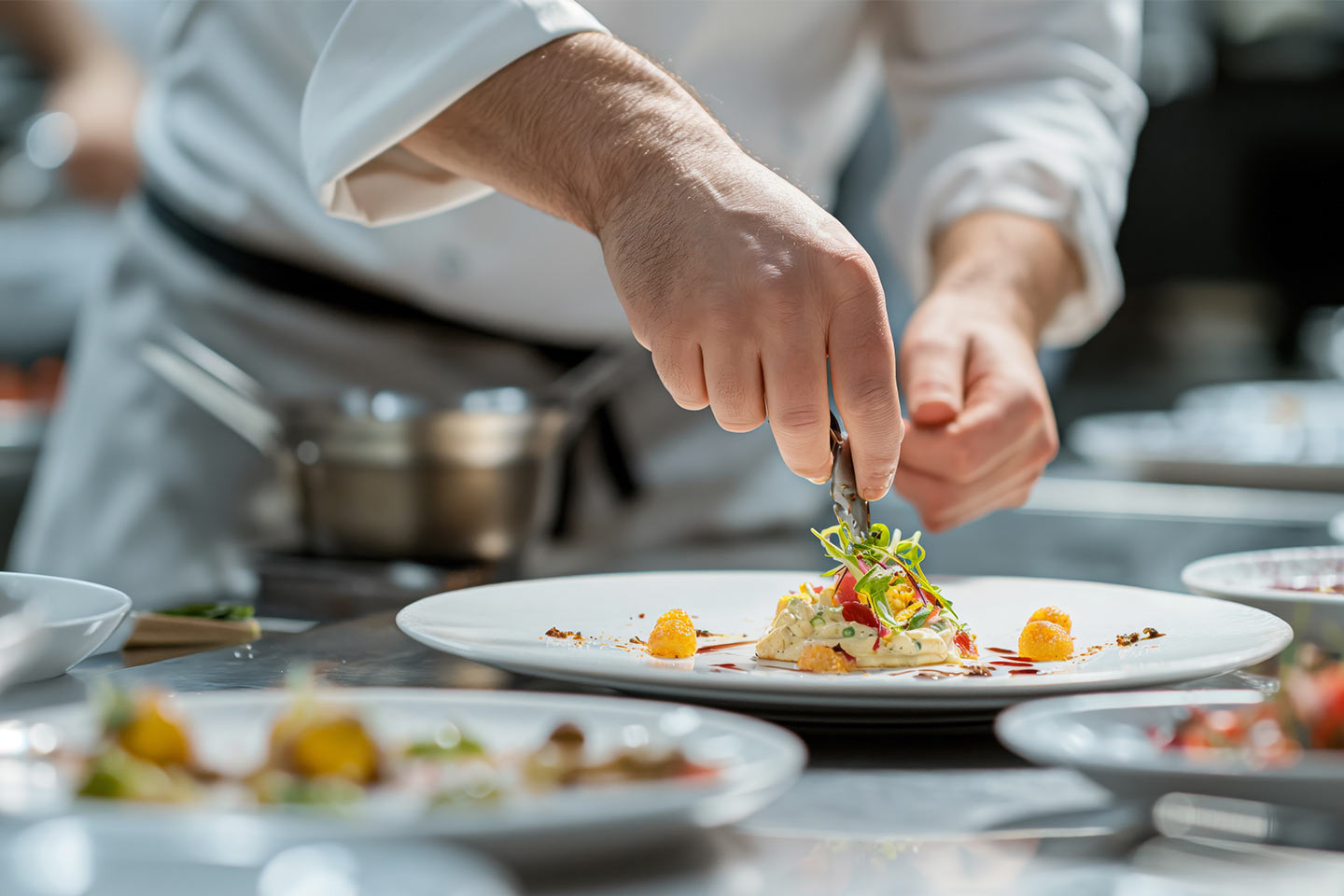
Culinary creativity begins before the plate arrives on the restaurant table. Discover how cross-modal orchestration shapes taste through sensory alignment and perception.
Culinary creativity is often judged by the originality and technique on the plate. Yet dining experiences begin to take shape long before any food is tasted. This article relocates culinary creativity to the orchestration of experiences across all senses beyond the plate and in context. By shifting attention from the plate to the perceptual conditions before consumption, culinary creativity can be understood as a form of cross‑modal alignment through which anticipation and meaning are shaped.
Where Culinary Experience Really Begins
A diner sits at a table. The plate has not yet arrived, but the experience has already begun. This is not a poetic claim so much as an empirical one. Long before food reaches the mouth, diners form expectations shaped by the room, the lighting, the soundscape, the pace of service, the weight of cutlery, the shapes and colors that appear, or deliberately do not appear, before them. Anticipation, memory and imagination are already doing perceptual work, setting sensory and hedonic expectations. Taste, in this sense, does not begin with eating. Once this is acknowledged, a curious question arises. If so much of the culinary experience unfolds prior to consumption, why is culinary creativity still so often discussed as though it resides primarily on the plate?
The Narrow Framing of Culinary Creativity
Culinary creativity is typically associated with outcomes: original dishes, novel techniques, unexpected combinations. This framing is intuitive and convenient. It renders creative cuisine visible, assessable and closely tied to execution. Yet it is also misleading. In creativity research more broadly, creativity has long been defined not simply by novelty, but by a combination of originality and appropriateness within a given context. In haute cuisine, that context is unusually complex. It includes diners’ expectations, cultural conventions, professional norms, evaluative institutions such as guides and rankings, and the tacit knowledge embedded in kitchen brigades and apprenticeship systems. From this perspective, the dish itself is not the source of creativity. It is where creativity becomes recognizable. The creative process unfolds earlier, across perception, sensemaking and judgment, long before execution stabilizes into form.
The Enduring and Intensifying Demand for Novelty
This misplacement has consequences, particularly when creativity is treated as something that must be continually delivered in finished form. Complaints about the pressure to innovate are not a recent development. Writing in 1907, Auguste Escoffier already described the exhaustion produced by diners’ unrelenting desire for novelty, noting the sleepless nights spent searching for new combinations. What has changed since then is the scale and intensity of evaluation. Contemporary chefs operate under conditions of permanent visibility. Rankings, guides, critics and digital media transform creativity from an occasional virtue into a continuous expectation. Unlike many creative professions, culinary creativity must be reproduced night after night, under time pressure, with high financial and reputational stakes and little tolerance for failure. Culinary creativity, in short, has become structural rather than episodic.
When Creativity and Well Being Collide
As creativity becomes central to many chefs’ professional identity, its psychological costs become harder to ignore. The deaths of Bernard Loiseau, Benoît Violier and Homaro Cantu are often described as tragic anomalies. However, they point to a broader structural tension in elite gastronomy, where creative performance, reputation, and self worth increasingly converge. Particularly in fine dining environments, high levels of stress, burnout, anxiety and substance abuse among chefs are reported. The paradox is striking. Creativity is widely described by chefs as the most meaningful aspect of their work, yet the pressure of constantly cooking is also among the most stressful. This suggests a systemic misunderstanding, not merely an individual failure of resilience. To address this tension, we must better understand where creativity actually operates.
Why Technology Does Not Solve the Problem
One response to this pressure has been to look towards technological solutions. Over the past two decades, computational gastronomy, flavor pairing algorithms and, more recently, generative artificial intelligence have promised to support food innovation. These tools are undoubtedly useful. They excel at recognizing patterns, recombining existing information and generating plausible variations. What they do not do is judge. Creativity in cooking involves intention, doubt, timing and responsibility. A dish is not simply a technical solution; it is a considered gesture addressed to others, grounded in embodied experience and social context. These elements cannot be delegated to systems that neither experience uncertainty nor bear the consequences of choice. Technology may assist creativity, but it cannot replace the perceptual and judgmental work that underpins it.
A Quiet Clue Hidden in Everyday Language
There is, however, another way of approaching the problem, one already embedded in culinary practice. Chefs routinely describe taste using terms that are not gustatory at all. Acidity is referred to as “sharp,” sweetness as “round.” Wines are described as “angular,” desserts as “soft,” dishes as “quiet,” menus as “loud.” This language is used with remarkable consistency but little explanation. Such descriptions are sometimes attributed to synesthesia, the rare condition in which stimulation of one sense involuntarily triggers experiences in another. Yet empirical research suggests synesthesia is relatively uncommon among chefs, and where it does occur, its highly idiosyncratic associations are rarely gastronomically helpful (or delicious). The explanation lies elsewhere.
Creativity as Perceptual Alignment
Most people share systematic associations between sensory modalities. Sweetness tends to be associated with round shapes, bitterness with angular ones, heaviness with low pitched sounds, acidity with brightness. These regularities, known as cross-modal correspondences, are neither metaphors nor artistic affectations. They are robust features of human perception. Once recognized, their relevance to culinary creativity becomes clear. Diners form expectations about flavor before tasting, based on visual, tactile and auditory cues. Chefs have long worked with these associations intuitively through plate design, textures, service rhythms, soundscapes and the orchestration of attention itself. Minor changes to form or context can alter perceived taste without any change to the recipe. A chocolate may be judged sweeter because it is rounder; a dish lighter because it is acoustically lighter. Creativity, here, is not located in the ingredients but in the alignment of perception.
Re-Locating Creativity in Gastronomy
Seen from this perspective, culinary creativity is less a matter of constant invention than of cross-modal orchestration, i.e., the deliberate alignment of sensory cues across sight, sound, touch, smell and expectation, through which culinary meaning and value are shaped before food is tasted. Creativity unfolds here through the careful shaping of anticipation, coherence and sensory significance across the entire culinary experience. This reframing helps explain why purely computational approaches repeatedly fall short, why technique alone cannot sustain innovation, and why creativity depends so strongly on leadership and environment. In the most resilient creative kitchens, chefs operate less as perpetual innovators than as conductors, structuring conditions, pacing change and recognizing when restraint is more generative than novelty. Creativity, in this sense, is driven not by adrenaline but by judgment.
A Clearer View of the Future
What this makes visible is that culinary creativity is not primarily an act of invention located in ingredients or techniques. It is an act of careful alignment of sensory expectations across modalities that allows food to be experienced as coherent and pleasurable. Once creativity is understood in these terms, it no longer belongs solely to the moment of cooking, but unfolds earlier, through perception and anticipation. This is culinary creativity before the plate.