The 2025 Bordeaux En Primeur campaign is now roughly half over. Many Bordeaux châteaux have already released their latest vintage, while several major names have yet to announce their prices. At this stage, no wine has sold out. At first glance, this might suggest a lackluster campaign driven by unattractive wines. That would be a premature conclusion. The reality is more nuanced and more interesting. After several difficult campaigns, 2025 may well be the first vintage in years to offer genuine opportunities.
Should You Pay Attention to Bordeaux 2025?
Yes, but not blindly.
The fact that no wines have sold out does not mean the vintage lacks appeal. Rather, it reflects the extreme caution weighing on buyers. After several disappointing campaigns, the Place de Bordeaux is paying for past mistakes: too many wines purchased En Primeur can now be found on the secondary market at lower prices. In that environment, waiting is a rational strategy.
However, buyer caution should not be mistaken for a lack of opportunity. Some wines already released are being offered at genuinely attractive levels, and others may follow.
Why might this year be different? Because, for the first time in many years, two important conditions are in place. First, the vintage has the profile of a vintage worth buying En Primeur: quality is high and volumes are limited. Second, after several underwhelming campaigns, châteaux can ill afford another disappointing release season.
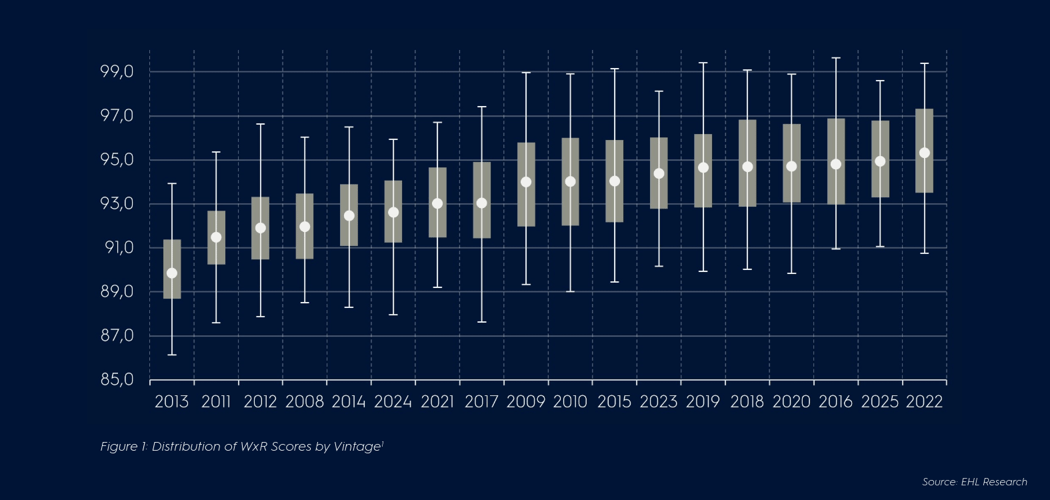
Figure 1 places the 2025 vintage in the context of the previous 18 vintages. It presents several descriptive statistics for the ratings of the wines included in our analysis. To limit individual biases arising from critics’ preferences and scoring scales, and to maximize comparability across vintages, we use Wine Expert Rating (WxR) scores, which are based on the evaluations of 21 reference critics. The figure reports the median score, the first and third quartiles (25th and 75th percentiles), as well as the minimum and maximum scores observed for each vintage. The results indicate that 2025 ranks among the three best vintages of the period, just behind 2022 and slightly ahead of 2016.
How the En Primeur System Lost Momentum
A brief look at recent vintages helps explain the current situation. Over the past several years, the En Primeur system has become increasingly less effective.
-
2021: a difficult vintage with weak demand.
-
2022: another “vintage of the century,” yet a mixed commercial reception.
-
2023: a very good vintage, but little real enthusiasm from buyers.
-
2024: a more heterogeneous vintage that generated limited interest.
Several factors may explain this trend: slower global demand, changing consumption habits, reduced wine investor participation and the broader correction in passion assets since 2022. Yet beyond these factors, pricing remains the central issue. For an En Primeur purchase to be attractive, it must offer sufficient expected value relative to comparable wines already available on the market. In recent years, however, many Bordeaux wines purchased En Primeur have subsequently become available on the secondary market at similar or even lower prices.
Under such circumstances, waiting is often the rational choice.
How Did We Get Here?
Two economic mechanisms appear to have played an important role.
The first concerns the way in which value is distributed along the supply chain. During the years of rapidly rising prices, a significant share of the value created by Bordeaux’s leading estates accrued to investors and intermediaries. It is therefore understandable that producers gradually sought to capture a larger portion of that value through higher release prices.
The second concerns reputation. In markets for scarce, high-quality goods, reputation is a critical asset. It shapes buyer expectations, reduces uncertainty and supports demand over the long term. In this context, pricing serves a dual purpose: it generates short-term revenue but it also influences how buyers perceive future opportunities. When release prices appear persistently disconnected from secondary-market values, confidence can gradually erode and buyers become more selective. Conversely, prices perceived as fair and consistent enhance the credibility of the system and encourage sustained participation in future campaigns.
Good Wine, Very Good Wine, Great Wine
With the 2025 vintage, Bordeaux has an opportunity to strengthen this reservoir of trust. The vintage combines high quality with relatively limited production. If prices remain consistent with market conditions, it could help realign the interests of producers and buyers.
A good wine is a wine that is sold.
A very good wine is a wine that is drunk.
And a great wine is a wine that is remembered after it has been drunk.
In the long run, the vitality of the market depends above all on consumers who buy wines, cellar them, and ultimately enjoy them. It is this genuine end-user demand that underpins the long-term strength of the Place de Bordeaux.
Estimating Fair Release Prices for Bordeaux 2025
The same methodology previously applied to Bordeaux 2024 has been used to evaluate Bordeaux 2025. The idea is straightforward: a fair release price is the price at which a well-informed wine buyer would be largely indifferent between purchasing the 2025 wine En Primeur and buying a comparable vintage already available on the market. The objective is therefore not to identify a “bargain” price, but rather a price consistent with the quality of the vintage, the château’s reputation, available critic scores, prevailing market conditions, and prices observed on the secondary market.
Three situations can arise:
1. Price on Par with Model
If you are looking to build or expand a cellar of fine Bordeaux for future consumption, wines priced close to the model estimates deserve serious consideration.
2. Price Lower Than the Model
These are the most attractive opportunities, particularly in a market that still offers many alternatives among recent vintages. If your cellar is already well stocked, these wines should be your primary focus.
3. Price Higher Than the Model
Proceed with caution! For certain rare wines, a modest premium may be justified because of scarcity or personal attachment to a château. However, when the premium becomes substantial, there is little urgency to buy.
Figures 2A and 2B compare the actual release prices of wines already released with the prices predicted by the model, expressed in euros (final consumer prices excluding VAT). As a preliminary observation, release prices are on average nearly 10% higher than those of the 2024 vintage. In other words, despite a weaker market environment, many châteaux have implemented moderate price increases. Overall however, the model suggests that pricing is better aligned with market conditions than in recent campaigns. The median difference between release prices and model-implied prices is even slightly negative, suggesting that most wines are priced appropriately. This largely reflects the ratings assigned by leading critics, which place the 2025 vintage well above 2024 and only slightly below 2022 (see Figure 1).
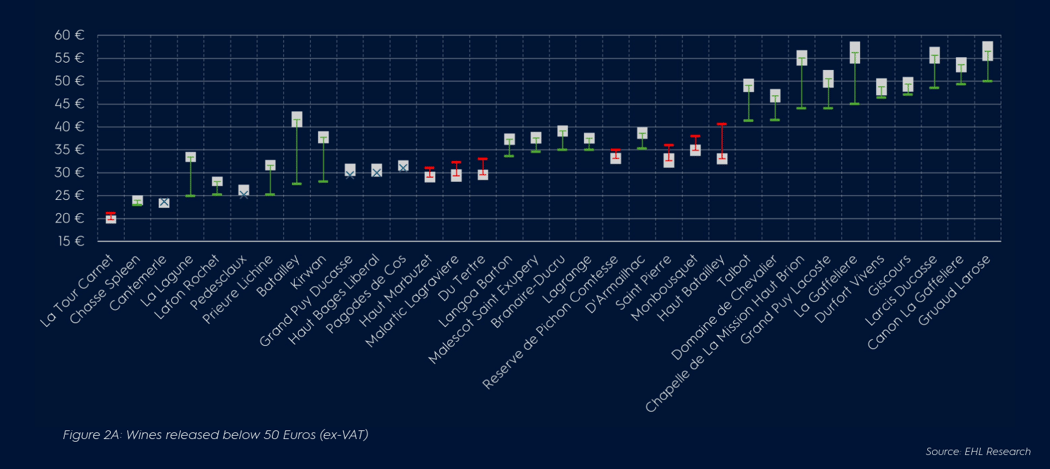
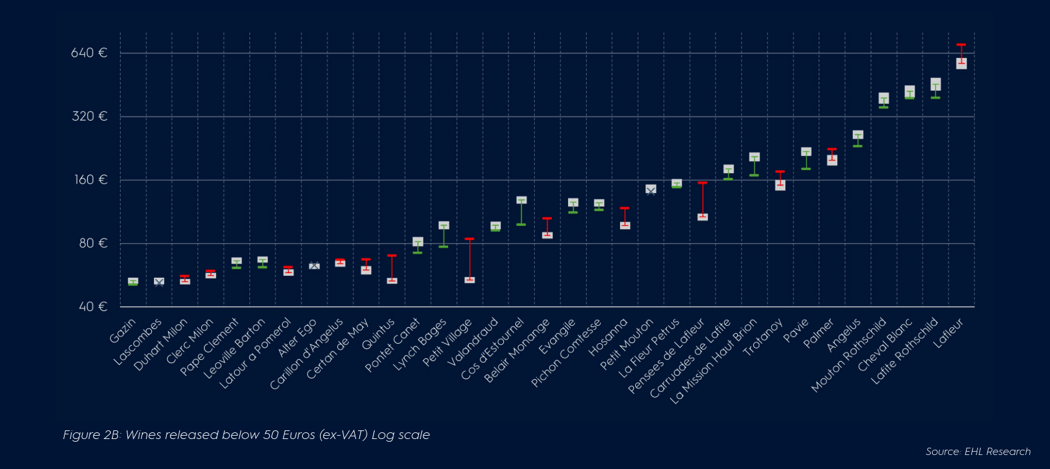
Note: The shaded gray areas represent the model-implied price intervals, reflecting estimation uncertainty. The bars show deviations from these intervals, with green bars indicating prices below the model-implied range and red bars indicating prices above it.
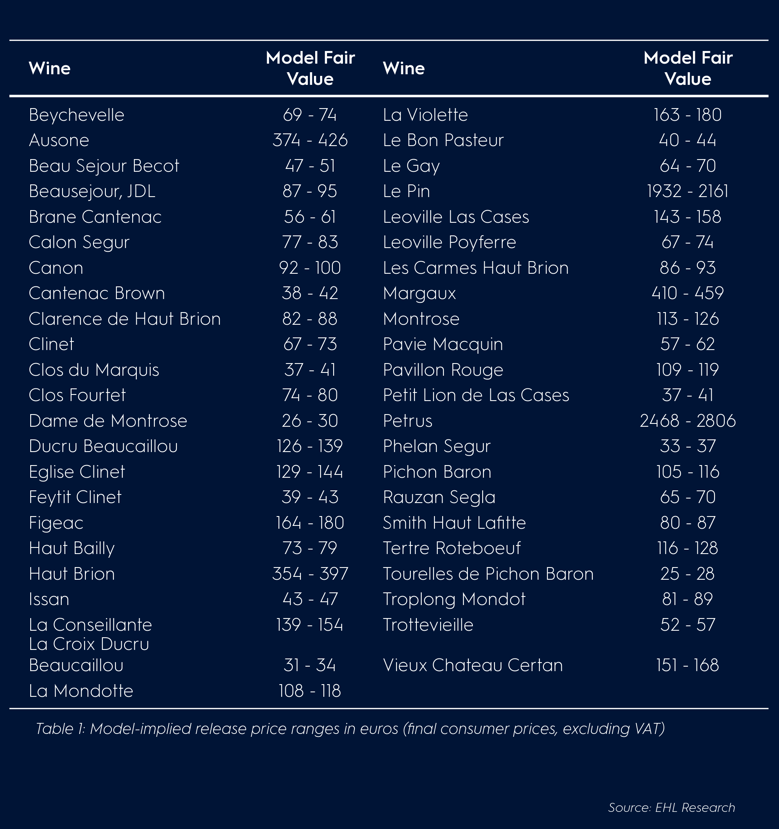
Table 1 reports the model-implied release price ranges for Bordeaux wines that have not yet been released. The reported 95% intervals provide benchmarks for assessing whether upcoming releases offer a compelling reason to buy En Primeur.
How Should Buyers Position Themselves?
For Bordeaux enthusiasts, the message is relatively straightforward: for the first time in several vintages, a significant share of wines appears to be offered at prices broadly in line with current market conditions.
Of course, there are no guarantees regarding future price movements. Yet, after several years of market correction, the balance between downside risk and upside potential now appears more favorable for wines that are appropriately priced.
This does not mean that buyers should go on a shopping spree. Selectivity remains essential. But the 2025 vintage once again offers situations in which buying En Primeur can be economically justified.
What About Bordeaux Producers?
For producers, the main challenge is trust. Even when a vintage is of high quality and prices are more reasonable, buyers may still have cold feet after several disappointing campaigns.
In this context, a strategy that prioritizes the release of initial tranches at attractive prices could help gradually restore market momentum. For châteaux, the objective is not merely to maximize the price achieved in a given campaign, but also to encourage participation in future campaigns.
Some estates may fear that lowering prices could weaken their image. Yet in prestige markets, reputation depends less on the absolute level of prices than on consistency between quality, scarcity and perceived value. Under certain circumstances, adjusting prices to market conditions can therefore be as much a reputational investment as a commercial decision.
Conclusion: A Vintage Not to be Missed
In the longer term, the En Primeur system may need to be reconsidered more fundamentally: release mechanisms, pricing practices, tranche management, and relationships with end consumers may all deserve renewed attention.
For this year, however, it is too late to reinvent the system. The main variable that remains is price.
With appropriate pricing, the 2025 campaign can succeed. Buyers will feel that they are gaining access to great Bordeaux wines at prices that are (finally) reasonable. Producers will benefit from much-needed cash flow. And the Place de Bordeaux as a whole will be able to begin rebuilding a reservoir of trust that has been significantly eroded in recent years.
Bordeaux 2025 is therefore not a vintage to buy without first doing the due diligence. But it may well be the first vintage in a long time that truly deserves a closer look.
1The aggregated ratings used in this analysis are derived from the Wine Expert Rating (WxR), developed by Wine Services. WxR scores are based on the evaluations of 21 leading critics, with systematic differences in scoring scales normalized before aggregation.

Reuse and reproduction permitted with full attribution to the original author and inclusion of a link to the original publication. All other rights reserved.