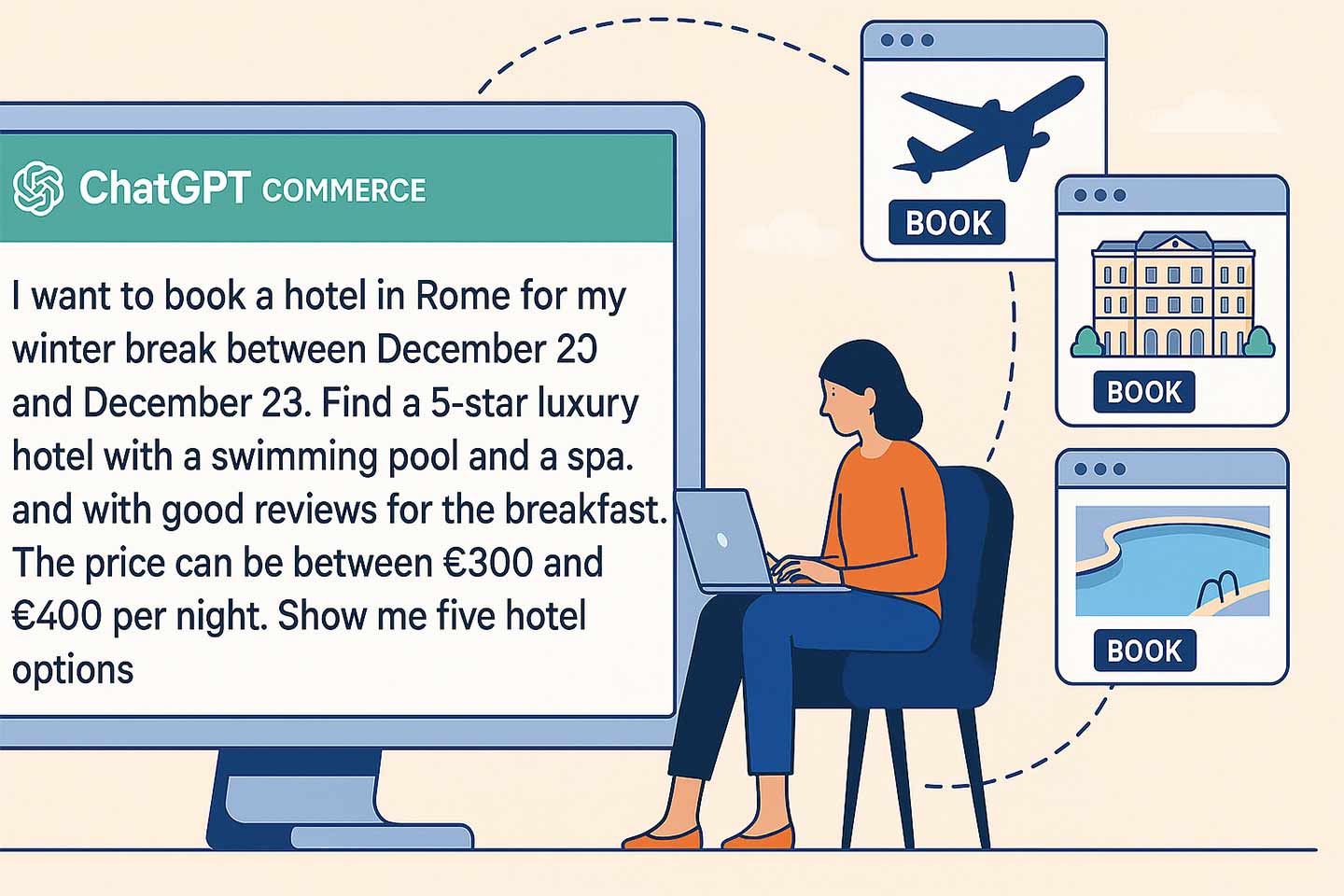
The travel industry is standing at the edge of another seismic shift. Just as online travel agencies (OTAs) revolutionized hotel distribution two decades ago, a new player is emerging; not a company, but an algorithm. With ChatGPT now capable of completing real transactions, artificial intelligence is moving from inspiration to execution, transforming how travelers search, compare, and book their stays.
A New Era in Travel Distribution
When ChatGPT introduced the ability to make real purchases, it quietly opened the door to a new era of travel distribution: ChatGPT Commerce. This shift means that artificial intelligence isn’t just inspiring or informing travelers anymore, it’s becoming a full-service booking agent capable of finding, evaluating, and even negotiating deals on behalf of guests.
For hotel operators, this is both exciting and unsettling. ChatGPT Commerce could reshape the booking landscape as profoundly as OTAs did twenty years ago. It will redefine who controls the guest relationship, how pricing works, and what “distribution strategy” means in a world where machines talk to machines.
AI-driven Platforms are Emerging as the New Middlemen
Traditionally, a traveler searching for a hotel went through multiple touchpoints: Google, OTAs, metasearch engines, brand websites, review platforms, etc. Each layer served a purpose (discovery, comparison or transaction), and each took its share of commission. Soon, ChatGPT Commerce will compress this journey into a single, seamless dialogue. By connecting to live inventory systems through APIs, ChatGPT will transform from a search tool into a transactional platform.
A traveler might type: “Find me a boutique hotel in Rome near the Spanish Steps, under €300 a night, with breakfast and flexible cancellation.” Within seconds, ChatGPT analyzes hundreds of data points, filters the results and presents a few perfectly matched options. But here’s the real disruption: the conversation doesn’t end there. It will evolve into negotiation.
Traveler AI: “Can you offer a better rate for a five-night stay?”
Hotel AI: “We can offer €40 dining credit if you confirm within 12 hours.”
The AI books the stay, records the transaction, and might even go a step further to suggest dinner reservations or airport transfers. What once required multiple logins and human inputs now happens in a fluid, informative exchange.
When Pricing Becomes a Conversation
This kind of automated dialogue is, in fact, the natural extension of what hotels already do with dynamic pricing and personalization. Revenue management systems (RMS) continuously adjust rates based on demand and booking pace. Extending that logic to AI-to-AI negotiation simply adds a conversational layer. RMS parameters, such as minimum rate thresholds or upgrade triggers, guide how the AI negotiates with guest-facing agents like ChatGPT. The result is a smarter, faster, entirely automated form of commerce.
The implications are profound. Negotiation has always been part of hotel sales, but usually for group contracts or corporate accounts. Now, even individual travelers can access context-driven, real-time offers through their personal AI assistants.
In this model, ChatGPT Commerce could act like a digital travel agent, not only finding the best rate but creating new value through negotiation, possibly earning a small commission from the savings it secures. For hoteliers, it won’t replace human strategy, but it will automate the tactical layers of pricing, freeing revenue managers to focus on strategic growth and market positioning.

Will AI Eliminate OTAs? Understanding the Disintermediation Paradox
It’s tempting to view ChatGPT Commerce as the end of intermediaries. If travelers can simply talk to an AI to book hotels, why would OTAs exist? But in practice, it’s more complicated. If ChatGPT connects to Booking.com or Expedia for its data, those platforms will still own the transaction, even if the guest never visits their website. The OTA brand fades from the customer’s view, but its infrastructure remains essential in the background — and it still earns commission.
This creates what might be called the disintermediation paradox. The AI removes one layer of visibility but not necessarily the middleman. True disintermediation will only occur if hotels develop direct, AI-accessible distribution pathways. That means exposing their own APIs or partnering with connectivity providers that can feed live inventory and rates directly to AI marketplaces.
The strategic implication is clear. Hotels that invest in open API connectivity can compete directly in the AI-driven distribution ecosystem. Those that do not will continue to depend on intermediaries, regardless of how the booking interface evolves.
The New Distribution Playbook
For hotel operators, the shift to ChatGPT Commerce demands a rethink of distribution priorities. The focus can no longer be limited to managing OTA dashboards or negotiating wholesale rates. The new playbook centers on data and readiness for AI integration.
The first priority is API connectivity. Every hotel’s core systems — PMS, CRS, RMS and F&B POS — need to be capable of pushing and receiving live data through APIs. This is the foundation for being visible and bookable in AI-driven environments. Legacy, on-premise systems that can’t share real-time data will become serious liabilities.
The second priority is data quality and contextual design. In an AI-driven marketplace, hotel data must not only be accurate but also intelligible to machines. AI systems depend on information that is standardized, structured, and rich in context — enabling them to understand not only the data itself but how to apply it. Room types, amenities, and policies should follow recognized schemas such as schema.org for consistency, while rate plans and offers should include metadata linking prices to guest types, loyalty tiers, or stay durations.
An emerging framework called the Model Context Protocol (MCP) is making this possible. MCP is an open standard that enables AI systems to interpret and act on data in context, turning static content into actionable intelligence. While APIs make hotels visible, MCP makes them understandable. For hotels, this means redesigning data models to be not just machine-readable but machine-interpretable, paving the way for AI agents to recommend, personalize, and eventually facilitate bookings that reflect each property’s pricing logic, value proposition, and brand strategy.
Finally, hotels must embrace experimentation. AI commerce is still evolving; early adopters have the advantage. Partnering with forward-thinking channel managers, technology providers and AI marketplaces allows hotels to test new approaches to pricing, packaging, incentive models, etc. Over time, these experiments provide valuable insights into what types of offers maximize bookings and guest satisfaction. Strategic experimentation turns uncertainty into a learning engine, helping hotels refine AI-driven distribution while protecting profitability.
Looking Beyond the Interface
In the early 2000s, hoteliers debated whether to join OTAs. In the 2010s, they invested in direct booking campaigns. The 2020s will be defined by a new question: How do we become visible and transactable in the age of AI?
Generative AI Commerce represents a fundamental change in how consumers make decisions. The search bar is being replaced by a conversation. The rate plan is being replaced by dynamic negotiation. The website is being replaced by a data connection.
For hotels, the opportunity is enormous. The risk is equally so. Distribution strategy will no longer be about where you sell, but how intelligently your systems can communicate. As the first AI agents begin to book rooms on behalf of travelers, one truth becomes clear: In the new hotel booking game, your API is your storefront and your data is your salesperson.