Wine consumers may not realize it, but when they buy a bottle of wine, a substantial part of the price reflects reputation. For relatively inexpensive wines, the reputation of the region plays a major role. For more expensive wines, the reputation of the producer adds another layer. A Burgundy Pinot Noir or a Napa Cabernet will therefore typically sell for more than a wine made from the same grape variety and of comparable quality in a less prestigious region.
This hierarchy of regional reputations is often considered immutable. Yet it is not. Burgundy's grands crus command some of the highest wine prices in the world today, but this is relatively recent. Until the 1980s, Romanée-Conti was largely an exception. Conversely, Madeira once enjoyed worldwide prestige but has since become a niche market.
This article builds on a presentation and discussions at the Alliance for Research on Wine & Hospitality Management conference. It looks at emerging, re-emerging and declining wine regions and at the forces behind these movements. Why do wine regions rise and fall? Why do some enjoy a renaissance? And why do a small number appear remarkably resistant to any change at all?
Prestige Set
In the early 1990s, the table of contents of the wine list at the Tour d’Argent in Paris, famous for its extraordinary cellar, had only four headings: Champagne, Burgundy, Bordeaux, and Vins des régions. Three regions had a status of their own; everything else was relegated to the “other” category. Today, the Tour d’Argent lists around 15,000 references from a much broader range of regions. Its selection includes the “icons of the Rhône Valley, gems from the Loire, treasures from Jura, Corsica and Beaujolais”. What was once a residual category now includes several regions with strong identities and their own prestige wines.
We call the group of wine regions that command sustained recognition and significant price premiums beyond their home markets the ‘prestige set’. Membership does not require every wine from a region to be prestigious. Rather, a region enters the prestige set when enough of its leading producers and wines achieve international recognition.
The evolution of the prestige set involves two distinct processes.
-
The first is movement within the prestige hierarchy. Regions already inside the set can gain or lose relative standing. Burgundy's rise relative to Bordeaux is a striking example in recent times. Such movements shake up the hierarchy without necessarily changing the boundaries of the prestige set.
-
The second is the expansion of the prestige set itself. Regions that once stood outside the global fine-wine hierarchy can enter it. The evolution of the Tour d’Argent list illustrates this process within France: regions once cloaked with the unflattering moniker Vins des régions have acquired distinct identities and reputations of their own.
Globally, the expansion has been even more striking. Ironically, the Tour d’Argent remains almost exclusively French, apart from a few old Ports. This is particularly notable because its former sommelier Christian Vanneque was a member of the jury at the 1976 Judgment of Paris, when Californian wines famously defeated leading French wines. The event became a symbol of the emergence of New World wine. Today, the finest wines from Napa and Sonoma can be as expensive as their Bordeaux counterparts.
A century ago, the map of fine wine was remarkably small. Today, it stretches from Burgundy to Barossa, from Rioja to Mendoza. The story of wine prestige is therefore not simply one of winners and losers within a fixed hierarchy. It is the story of a hierarchy whose boundaries have expanded, bringing an ever-growing number of regions into the global prestige set.

Indicators of the Emergence of a Wine Region
How can we tell that a region is entering or has entered the prestige set?
Several signals point in that direction. The wines of a previously little-known region receive increasing media attention, high ratings and recognition outside their area of production. A growing number of producers develop strong reputations. The physical size of vineyards may expand as demand and investment follow.
Distribution provides another indication. Wines from emerging regions start appearing at leading wine merchants, on the lists of gastronomic restaurants and in high-quality wine bars. A substantial share of production is increasingly consumed outside the region itself.
For wine lovers, unfortunately, prices provide perhaps the clearest signal. Relative prices tend to rise alongside reputation; high absolute prices and trading activity on secondary markets suggest that at least the leading wines of a region have fully entered the prestige market.
We will see more and more regions jumping into the game.
-
Marc Almert, ASI's World's Best Sommelier in 2019
Factors of Emergence and Decline
Wine regions rise and fall for many reasons. Climate, pests and diseases, transport, trade barriers, regulation, politics, know-how, and shifting consumer preferences have all reshaped the wine landscape.
Climate
Climate change is already creating winners and losers. The rise of English sparkling wine, the growing reputation of Etna, and even the emergence of vineyards in northerly regions such as Belgium and Scandinavia would have been difficult to imagine without warmer conditions.
The effects can also work in the opposite direction. Historically cooler regions may need to change grape varieties, vineyard practices or wine styles to preserve their reputation.
Climate can also spark a renaissance. German Riesling provides an interesting example. Germany once earned its reputation with outstanding sweet wines, produced under cooler conditions that often limited full ripeness. As demand shifted toward dry wines, warming temperatures allowed grapes to ripen more consistently, helping German Rieslings reclaim their status among the world's finest whites.
Consumer Preferences
The vagaries of consumer preferences can be a change agent that is just as powerful as climate change. Wine has gradually shifted from being part of everyday consumption in a relatively small number of traditional wine-producing countries toward more occasional, premium and luxury consumption across a much wider range of markets. This favors regions producing distinctive fine wines and puts pressure on regions historically dependent on mass-market production.
Styles also move in and out of fashion. Declining demand for sweet and fortified wines has hurt regions such as Sauternes, Jerez and Madeira. Vineyard area in Jerez plummeted from around 29,000 hectares in 1970 to less than 7,000 hectares in 2022.
The current preference for wines with lower alcohol levels could create new winners and losers. Regions associated with powerful styles, such as Amarone della Valpolicella, may have to adapt.
Transport, Trade… and Politics
The geography of wine has always depended partly on access to markets. Bordeaux and Porto benefited centuries ago from easy maritime access to England and a preferential customs regime; fortification made wines more suitable for long-distance transport.
Politics and trade policy can be equally important. The historical importance of Algeria and South Africa as wine producers was closely linked to political conditions and access to specific markets. Today, the return of protectionist policies could again reshape production and consumption, potentially favoring domestic regions such as Texas or the Finger Lakes in the United States.
Pests, Diseases, and Production Costs
Pests and diseases have repeatedly redrawn the wine map. Rioja’s initial rise was closely linked to the arrival of phylloxera in France in the late 19th century.
The introduction of powdery and downy mildew from the Americas also increased vineyard costs, particularly in steep regions where mechanization is difficult. Many vineyards in regions such as the Mosel, Valtellina and Northern Rhône were subsequently abandoned.
Some of these regions later re-emerged, but often in a different form. More than half a century ago, outstanding vines were ripped out in diverse areas such as the Mosel/Saar/Ruwer, Ribeira Sacra, Cornas, and Côte-Rôtie, while even Hermitage came under pressure.
Decline, in other words, need not be permanent. It can reduce production, concentrate activity on the best sites and producers, and eventually lay the foundations for a renaissance.
Dissecting the Prestige Set
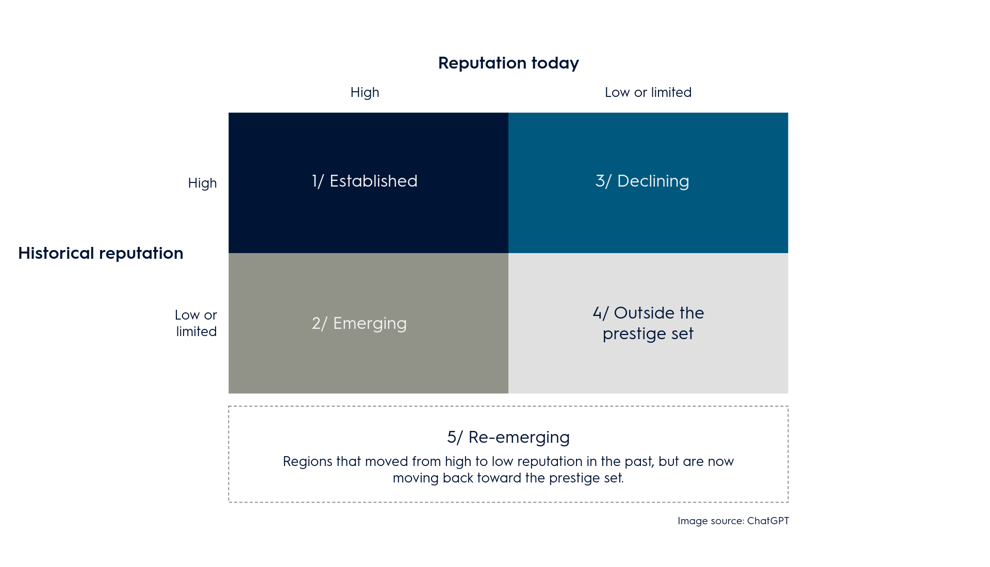
The prestige set is dynamic. Regions can enter it, move within it, leave it, and occasionally return. A simple way to organize these trajectories is to compare historical and current reputation.
1/ Established Regions
Regions in this category are firmly established near the top of the reputational hierarchy. Examples include Bordeaux, Burgundy, Champagne, Piedmont, Tuscany and California.
Within this group, a small number can be described as classic regions. They have maintained a very high level of quality and reputation for a long period and contain enough outstanding producers for the reputation to belong to the region rather than to a handful of individual estates. Champagne, Burgundy and Bordeaux are obvious examples.
Classic does not mean impervious to decline. These regions experience economic cycles, difficult vintages, and capricious demand like everyone else. Their advantage is resilience. Their accumulated reputation gives them more room to absorb shocks before their position is fundamentally threatened.
Bordeaux's current difficulties are therefore particularly interesting. Even one of the world's strongest regional wine brands cannot take its position for granted.
2/ Emerging Regions
Emerging regions are moving toward or into the prestige set. The process often begins with a small number of exceptional producers. As other producers follow, reputation gradually shifts from individual names to the region itself. Oregon, Washington State, Mendoza, and Ningxia provide possible examples at different stages of this process.
Emergence is therefore not simply about improving wine quality. It requires the market to recognize that quality, and then increasingly attach value to the regional name.
3/ Declining Regions
Declining regions once belonged to the prestige set but have slipped in terms of visibility, demand or pricing power on international markets. Supply eventually follows demand. Jerez, Madeira and Sauternes illustrate different versions of this downward trajectory. Their wines may remain outstanding, but the market no longer assigns the same value to the regional reputation.
Importantly, decline in reputation does not necessarily imply decline in quality.
4/ Outside the Prestige Set
Most wine regions have never belonged to the prestige set. Their wines may be good or even excellent, but their regional name does not command sustained international recognition or a substantial price premium.
This category matters because emergence should be understood relative to it. A few successful producers do not automatically transform a region. Momentum builds when recognition begins to extend from individual wineries to the regional name itself.
5/ Re-emerging Regions
Some regions have experienced a more complex cycle. They once enjoyed high prestige, declined and later recovered.
The Mosel, Alto Piemonte and Tokaj are examples. Cornas and Côte-Rôtie also illustrate how abandoned or marginal vineyards can return to the top of the hierarchy when economics, production methods, climate and consumer preferences become favorable again.
Re-emergence is especially interesting because historical reputation can itself become an asset. A region does not necessarily need to build its identity from scratch; it may instead rediscover, reinterpret and market a reputation that already existed.
Conclusion
The hierarchy of wine regions is not set in stone. Regions rise, decline and sometimes return to the good graces of the markets. More importantly, the prestige set itself has expanded: many more regions now produce wines that command international recognition and high prices.
For wine enthusiasts, this is good news. Emerging and re-emerging regions bring greater diversity, while declining regions can offer outstanding wines at relatively attractive prices.
But reputation affects more than just price. In difficult markets, a strong regional reputation provides international visibility, pricing power and loyal demand. Reputation drives price and provides a buffer in bad times.
Climate change, changing consumer preferences and trade conditions will continue to reshape the hierarchy. Some peripheral regions will enter the prestige set; some established regions may lose ground. The map of wine prestige will keep changing, and that is part of what makes wine so fascinating.

Reuse and reproduction permitted with full attribution to the original author and inclusion of a link to the original publication. All other rights reserved.